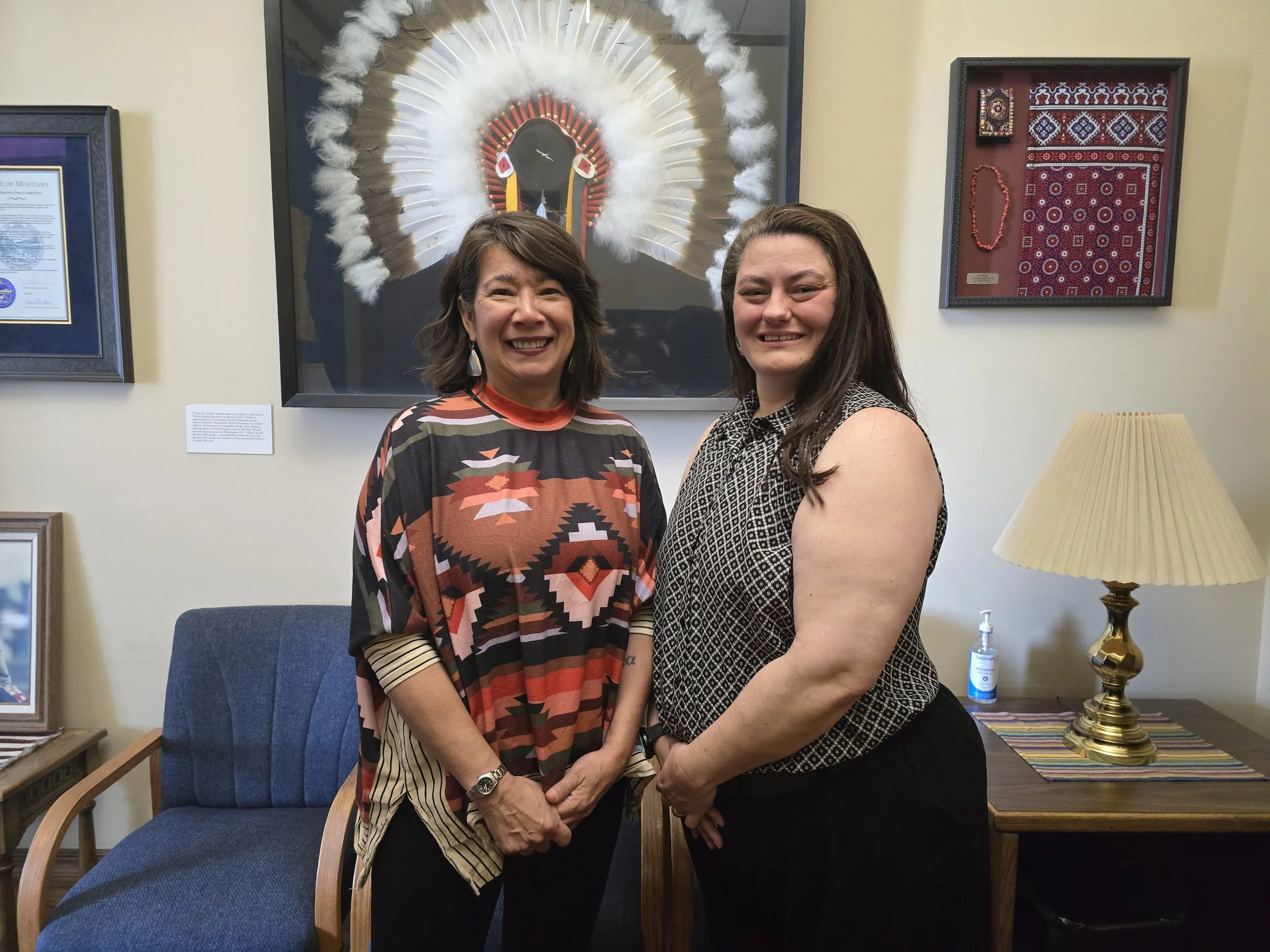
Hi, I’m Dr. Tosha Sautbine!
My academic journey began in 2013. Thirteen years later, I completed my PhD in Interdisciplinary Studies with concentrations in Native American Studies, Natural Resource Law, Environmental Justice, and Business Administration. My doctoral studies integrated three years of law school coursework with a certificate in Natural Resource & Environmental Policy Conflict Resolution.
Life unfolded along the way, as it does. The losses of two of my children shifted my timeline and deepened my understanding of what people carry. Those years were not a detour. They became part of the work itself. I kept going because I believe that everyone deserves to be heard, that every community deserves laws that protect them, and that the Treaties made with our ancestors must be honored.
I am an Oglala Lakota and Cherokee Nation descendant. I have worked with the Montana Innocence Project and Western Native Voice. I am pictured with Montana Director of Indian Affairs Misti Kuhl during my policy advocacy with Western Native Voice to expand ICWA protections in Montana, work that reflects my commitment to ensuring Tribal Nations have a voice in the laws that affect their children and their future.
Every part of this journey shapes how I show up now. I aim to help Tribes and communities resolve complex disputes and advocate for policies that honor Treaties and protect communities.
I relocated July 2026 to the Salt Lake City, Utah area to open my practice. I serve clients in person across Utah and remotely nationwide.
My Guiding Principles for
Tribal Nation Collaborations
I listen first. Before any strategy or solution, I take time to understand your story, your goals, and what is truly at stake. From there, I build a framework rooted in my Sovereign Quadruple Bottom Line.
In my own formulation of the Sovereign Quadruple Bottom Line, developed throughout my forthcoming book, I root the analysis in Takamura and Walters' four foundational pillars of Community, Spirituality, Sustainability, and Entrepreneurship.
I critically expand the model by introducing Legal and Policy Frameworks as a necessary fifth pillar, and I reposition Sovereignty not as a component but as the central organizing axis around which everything turns. This yields four interrelated mandates, namely honoring cultural Sovereignty, advancing environmental justice, strengthening economic resilience, and upholding the legal and policy frameworks that protect them.
These five pillars guide every mediation and every policy effort I undertake. Cultural Sovereignty means Tribal Nations retain their voice, their identity, and their right to determine their own futures. Environmental justice ensures that communities long burdened by pollution and policy neglect finally have a seat at the table. Economic resilience creates pathways for sustainable growth that do not come at the cost of tradition or land. The legal and policy frameworks that protect them must be honored, enforced, and when necessary, rewritten.
Whether I am mediating a dispute between a Tribe and a state agency or drafting a policy document for legislative advocacy, my work is designed to create outcomes that are not just resolved, but right. Lasting solutions come when people feel truly heard, when their history is respected, and when the agreements we build together hold weight for the seven generations to come.
That is what I mean by the Sovereign Quadruple Bottom Line. That is what guides every conversation, every document, every strategy I touch.